
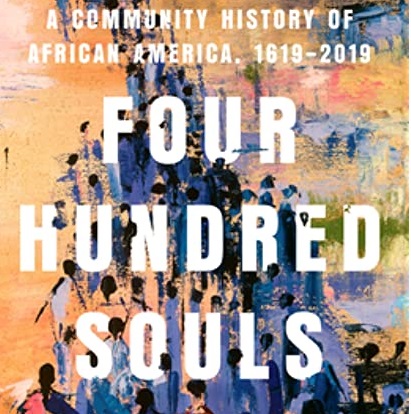
Focus: “The contradictions between these two founding arrivals–the Mayflower and the White Lion–would lead to the deadliest war in American history, fought over how much of our nation would be enslaved and how much would be free. They would lead us to spend a century seeking to expand democracy abroad, beckoning other lands to “Give me your tired, your poor, Your huddled masses yearning to breathe free,” while violently suppressing democracy at home for the descendants of those involuntary immigrants who arrived on ships like the White Lion. They would lead to the elections–back-to-back–of the first Black president and then of a white nationalist one.”
Tonight we discuss the arrival of those involuntary immigrants and the evolution of the thinking, customs, policies, and laws that evolved that slowly took away any chance that the labor force had at establishing their freedom; we look at he devolution of a people to chattel.
Gathering Prayer: Holy One who is known to us by many names and in many ways, wegive thanks for the blessings that we have in our lives. You know the thoughts of our hearts; hear our prayers. Be present now as we enter a time of thought and discussion.
Sentences on the Subject: “If the Mayflower was the advent of American freedom, then the White Lion was the advent of American slavery. And so while arriving just a year apart, one ship and its people have been immortalized, the other completely erased. W.E.B DuBois called such erasure the propaganda of history. ‘It is propaganda like this that led men in the past to insist that history is lies agreed upon.’ ….. what is clear is that while we can erase the memory of the White Lion, we cannot erase its impact.”
*******
Elizabeth Keye would instigate the single most important legislative act concerning the history of enslavement, race, and reproduction in the colonial Atlantic world. In 1662 the Virginia legislature decreed that a child born to an African woman slave, no matter who the father was, would follow that woman into slavery. This piece of legislation encapsulated the early modern understanding of racial slavery—that it was a category of labor that African people and their descendants inherited.
*******
He knew his business dismayed his uncle. Betrayed his namesake. He had read The Selling of Joseph, of course; the old man had seen to that. But he had also read the rebuttal from Judge John Saffin. He had been comforted by the argument that hierarchies were necessary, that bondage was natural, that the enslavement of negroes was part of an orderly, divine world. He had been convinced of his own godliness by the idea that “Cowardly and cruel are those Blacks innate.” He had made peace with what the province, with what his place in it, required. The doubts, the troubling idea that he was a man-stealer, a seller of his own brethren, had faded with each successful sale of a negro slave. Apprehension gave way to conviction. To self-assurance. To the unassailable belief that liberty required slavery. Capital was the real god of this new world, he thought. The future belonged to him; his uncle’s protest was already forgotten.
******
In 1680, four years after the rebellion, Virginia passed the Law for Preventing Negro Insurrections……….The goal, as it has been ever since, was to offer just enough racial privileges for white workers to identify with their color instead of their class. The Virginia legislature ended the penalties imposed on rebels for the insurrection of 1676, but only the white ones, removing a source of lingering solidarity among them. Post -Bacon reforms forbade Black people to carry anything that could be considered a weapon, but they made sure that every manumitted indentured servant was given a musket……A decade after Bacon, the governing class made a final decision to ensure the loyalty of white servants: simply have fewer of them. A critical mass of white working people threatened their racial slavery order, so Virginia plantation owners imported more Africans, whose rights they could drastically limit through legislation. By the end of the eighteenth century, the gentry were relying almost entirely on Africans for their labor. They stopped importing white servants from England, save to meet a Britain-imposed quota to ensure the presence of enough armed white people to defend against slave rebellions.
******
Known colloquially as the “slave codes,” the 1705 Act Concerning Servants and Slaves was an effort at finality. It put an end to decades of debating over how to make it clear that Virginia was a white man’s colony, one in which a white man’s colonial investment was secure, and one in which the law protected the white man’s right to enslave Black people. It became the model for all the British colonies in North America. One colony after another codified its racial caste systems and assured white planters that they could enslave increasing numbers of Black people.
Below is some “food for thought”, a few probes that might kick start a conversation. Read over them and pick one (or more, or none) to discuss. Remember to hold space for others to share and share only what you feel comfortable sharing.
Probe 1. Consider the formation of two very different world views/ ideas/even foundational to America: the mythical place the Mayflower holds in our national history and the little know story of the White Lion. How might we be different if we were taught a different history?
Probe 2.The inheritance of family linage was of critical importance. In Europeanaristocracy it was patrilineral; in Judaism matrilineral. Why was the decision(s) surrounding Elizabeth Keye so critical to Virginia society? What other practices or laws come to mind that helped solidify the unfree labor economy?
Probe 3. Despite his Uncle’s appeal to the human indignity of slavery (The Selling of Joseph), Samuel Sewell had made peace with his role in the slave economy. In what way did the Christian Church likewise make peace with slavery in its community? How has it made peace with the racism of today?
Probe 4. Like the1619 Project and Critical Race Theory,400 Souls seeks to reframe our country’s history by shifting a focus onto the role of slavery and Black Americans. Have these stories shifted your thinking on early Colonial Period and slavery? How? What stories or examples can you share?
Commission: Hold on to what is good. Love deeply. Honor others. Stay excited about life and your faith. Be joyful. Be patient. If you pray, have faith. Share with people who are in need. Welcome others into your homes. Be loving to those who hurt you. Be present; be in the moment. Be gentle, even with those with whom you disagree. Be humble. Be a friend of people who aren’t considered important. Do the right thing. If possible, live in peace with everyone. And remember, no matter who you are, or where you are on life’s journey- you are welcome here.

 My Thoughts and the Thoughts of Others